
Your Reformer Cheat Sheet: Everything That WIll Make Class #2 Click
If your first class is in the books, you already know more than you think. You got the intro, you moved through it, and you probably left with a handful of questions you didn't want to slow things down to ask. Good news! This is exactly where those get answered.
Here's what's actually happening with each part of the machine and why it matters for how you move.
The Carriage
You already know this is what you're lying, sitting, or standing on. What's worth understanding now is that controlling the carriage is the workout. When your instructor says "resist the carriage on the way in" or "don't let it snap back," they're asking your muscles to do the eccentric work. The lengthening under load that's responsible for a lot of what makes Pilates so effective. The smoother and more controlled your carriage moves, the more your body is actually working.
The Footbar
The footbar adjusts in height, and that height changes the geometry of every exercise built around it. A lower footbar in footwork puts your legs in a different line than a higher one and your instructor is making that call based on your proportions and the specific movement. If something ever feels off in your hips or low back during footwork, the footbar height is often the first thing worth checking.
The Shoulder Blocks
These aren't handles. They're a reference point and a gentle boundary that tells your body where "home" is on the carriage. If you find yourself actively bracing against them or feel like you're being pushed into them throughout an exercise, that's usually a signal that the spring load needs adjusting or your starting position is slightly off. Your instructor will catch it, but now you'll know what they're correcting.
The Straps
You'll use these with your feet, your hands, or both. When you switch between them mid-class, it's not arbitrary. The angle and anchor point of the strap changes which muscles are responsible for the movement.
The Headrest
It tilts up or lies flat, and it matters more than it looks like it does. Up supports your cervical spine during most supine work. Flat is used when the exercise calls for a neutral or extended spine, and moving it at the wrong moment can shift strain into your neck unnecessarily. If you're ever unsure, ask. It takes two seconds and it's always worth it.
The Risers and Pulleys
The tall posts at the back of the frame control the angle your straps travel through. That angle determines the line of pull and the line of pull determines which part of your body is doing the work. This is one of the more subtle mechanics of the reformer, but once you start noticing it, you'll understand why the same exercise can feel completely different from one class to the next.
Understanding the Springs
The springs are the most important thing to understand on the reformer, and they're also the most misunderstood. The instinct is to treat them like weight…more springs, harder workout. That's not quite how it works.
Springs create resistance, but they also create assistance. Depending on the exercise, adding a spring can actually make a movement easier by giving the carriage more to push against or pull from. Removing a spring forces your stabilizing muscles to work harder to control the carriage through its range of motion. Neither is inherently better, they're just asking different things of your body.
The Color System
The Merrithew V2 Max (what we use at Rêve!) uses a color-coded spring system. Each color corresponds to a different tension level:
Red — full spring, heaviest resistance
Blue — half spring
Yellow — quarter spring
White — extra light, often used for very targeted or rehabilitative work
Most exercises will call for a combination–two reds and a blue–for example. And your instructor will either set this for you or call out the load as class continues. As you get more familiar with the machine, you'll start to notice how different loads change the feel of the same movement.
More Springs vs. Fewer Springs
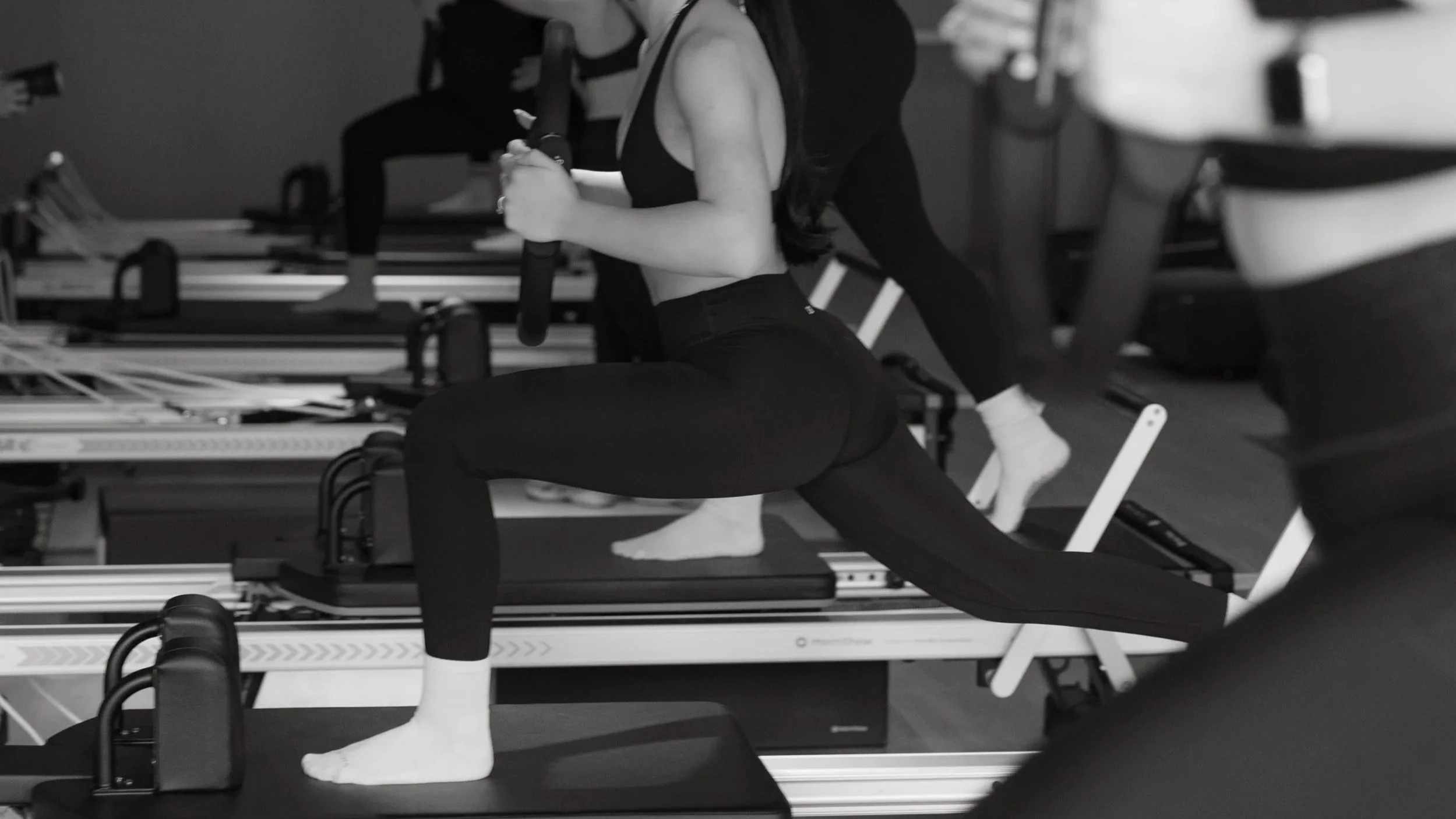
Here's the part that surprises most people. In exercises where the carriage moves away from the springs (like footwork pushing out) more springs means more resistance and more work to push. But in exercises where the carriage moves toward the springs (such as platform lunges) more springs actually makes it easier, because the spring is helping you complete the movement. Remove a spring in that same exercise and suddenly your body has to work much harder to control the return.
Your instructor is managing this constantly. When they adjust your springs mid-class, they're not just changing the difficulty—they're changing which muscles are being asked to lead.
A Useful Way to Think About It
If an exercise feels like you're working too hard to control the movement rather than perform it, you may have too little spring. If it feels too easy or the carriage is moving faster than your body wants it to, you may have too much. These are always worth flagging to your instructor, not because something is wrong, but because dialing in your spring load is one of the fastest ways to get more out of every class.
The Other Apparatuses
The reformer on its own is a complete system, but a few additional pieces of equipment attach to or work alongside it that you'll encounter in our classes. Here's what they do and why they show up when they do.
The Box
The box is a rectangular platform that sits on top of the carriage and changes your relationship to the machine entirely. It extends your surface area, elevates your position, and opens up a whole category of exercises that aren't possible on the carriage alone.
You'll use it in two orientations. Long box places it lengthwise on the carriage. This is where you'll find pulling and rowing exercises, prone back extension work, and some of the most challenging arm series on the reformer. Short box places it across the carriage. This is where spinal flexion, rotation, and side-body work lives. Short box series are deceptively difficult and tend to be where clients first really feel their core working in a meaningful way.
The Jumpboard
The jumpboard is a vertical platform that attaches to the footbar end of the reformer and turns the machine into a low-impact cardio apparatus. Instead of pressing the footbar, you're jumping against the board. Your feet begin leaving and returning to the surface while the carriage absorbs the impact through the springs. You’ll find these on the reformers during our Cardio Sculpt classes (typically found on weekends).
It looks playful, and it is, but it's also doing serious work. Because the springs reduce the load on your joints, jumpboard work lets you train explosive power and cardiovascular output without the impact stress of floor-based jumping. If you have a history of knee or hip issues, this is often where clients are surprised by how much they can do.
Tips for Getting the Most Out of Class #2
Tell your instructor what you felt after your first class.
Unexpectedly sore somewhere? Something that didn't click? A little confused? Say it before class starts. Thirty seconds of context lets your instructor adjust your load, positioning, or cues in ways that make a real difference.
Stop trying to keep up. Start trying to feel it.
The instinct in early classes is to match the pace of the room. The reformer rewards the opposite. Slower and felt is almost always better than faster and performed.
Ask about your springs.
You know what they're doing now! If something feels like you're fighting the machine rather than working with it, flag it. Getting your load right is one of the fastest ways to level up.
Expect it to feel different than last time.
Sleep, stress, hydration—the reformer picks up on all of it. A harder class isn't a step backward. It's the machine working exactly as designed.
Clients always say class two is where it clicks…where the machine starts to feel intuitive and you fully experience the Rêve effect. If you haven't booked your second class yet, do so here.
